Showing posts with label vegetarian. Show all posts

Spinach Provencal

I always liked spinach, but I never knew it could be so exciting until I tried my friend's grandmother Edith's spinach. I was visiting them over the holidays last year, and Edith made a lovely, typically Provencal baked spinach dish that I took several helpings of. It was wow.

What I make may not be a faithful representation of her dish, but this is the best I could remember. It's pretty good, and I don't remember if Edith used any herbs, but I don't. If you have any suggestions on what herbs would go well with this, I'd be glad to hear it!

You need:

tons of spinach (ok, this is about two and a half pounds, or just over a kilo)
1 cup green olives
10 to 12 cloves of garlic
olive oil - 4 tablespoons
salt and pepper (the pepper is buried behind the leaves)
1 and a half tablespoon of flour
1/2 cup of milk (not shown because I forgot)
1 and a half tablespoons of butter

Choose very good green olives that you like. The last time I made this, I didn't really like the taste of the olives I bought, and that effectively decides the taste of the whole dish. Best choose a green olive with a clean sharp saltiness.

First, wash your spinach. Don't put them in a colander and pour water over them; that will not get all the dirt out. Dunk them in small bunches into a large bowl full of water and shake them in the water vigorously, removing roots and red stems if still attached. Pull them out of the water, rinse under running water and put on a large colander.

Put about half and inch of water (in my case that was about 2 cups) in a heavy large pot over high heat. When the water is boiling, sprinkle some salt (half a teaspoon will do) then shove the spinach leaves in. My spinach required a lot of wrestling, but eventually I got it in and clapped on the lid.

After five minutes, open the lid and try to turn over the leaves. The bottom half will already be cooked , so just try to shove the raw leaves down and pull up the cooked ones on top. Put on the lid and wait two or three minutes more.

Remove from the pot and drain. Let water drip from the colander and lightly push the water out.

Give it a rough chop - I chopped it into sections about half an inch wide.

Heat a frying pan over medium heat with two tablespoons of olive oil and sliced garlic. When the oil starts simmering (but the garlic should not be browned) add the chopped spinach, squeezing the water out a little if dripping. You don't have to squeeze very hard, just enough so that it doesn't drip.

Saute for two or three minutes until the garlicky goodness is all over the spinach.

Put the spinach to one side of the frying pan and put the pat of butter and flour in the empty space. Let the butter melt, then mix the two to form a paste.

It doesn't matter if some spinach gets caught in it. Add the milk and stir with an wooden spoon until the paste is more or less dissolved.

Alternatively, if you have bechamel sauce on hand, you can just add about half a cup of that.

Now, mix the spinach in the bechamel sauce until evenly coated. If it seems a bit too dry/tacky/sticky, add a splash of water or milk, a spoon or two at a time. There should be a little liquid left at the bottom of the pan and nothing should be burning or sticking. Sprinkle a little salt - I used a quarter of a teaspoon. The spinach should be under-salted, to balance the strong salt of the olives. Do not over-salt the spinach!

Take the spinach off the heat, add the olives and stir. You can leave the olives whole, slice them or cut them lengthwise as I did - whatever you like. Take a taste and see if the salt is well balanced between the spinach and the olives.

Grease a baking pan with two tablespoons of olive oil. Pour the spinach mixture in and bake in an oven at 375 F for 15 minutes or until bubbly and starting to dry out on the surface. You can also add a few thin slices of toast or baguette on the top to make a crunch. Take care not to let the bread burn.

It goes well as an accompaniment to any meat or fish, but I can have this all by itself as lunch. A baguette and good cheese would make perfect companions.


Read More

Tofu noodle salad

This is my take on one of my favourite Chinese appetizers, a salad made with what I believe is dried tofu noodles. (Correct me if I'm laboring under false impressions.) I love it for the texture it has; a little chewy and rough in a good way. I've never been able to locate the exact source of the noodles, even in Chinese grocery stores (I really should ask the waitress) but I've tried it using "tofu noodles" found commonly in the states. 

Original tofu noodle salad, taken in Japan
These noodles are much softer and much less textured than the ones used in the salad (picture left) but I still like it. They're made by House and advertised as being low carb, gluten free and only 20 kcal per package. The gluten-free doesn't impress me (because tofu is not supposed to contain any wheat anyway) but 20 kcal per serving sounds like a good idea. I don't know why they call them "Tofu Shirataki" though - shirataki looks similar, but is a whole different product, made with konnyaku (konjac in English?) and has a different taste and texture. But I digress.


What you need: (per person)

1 package of Tofu "shirataki" noodles - I use the thinnest kind for this salad, but you're free to try the flat kind!
leek - about an inch and a half of the white part
1 teaspoon Chinese chicken bouillon powder
2 teaspoons sesame seed oil
dash of black pepper

(optional: 1 teaspoon rice vinegar, some lettuce, some other vegetables such as cucumber or peppers)

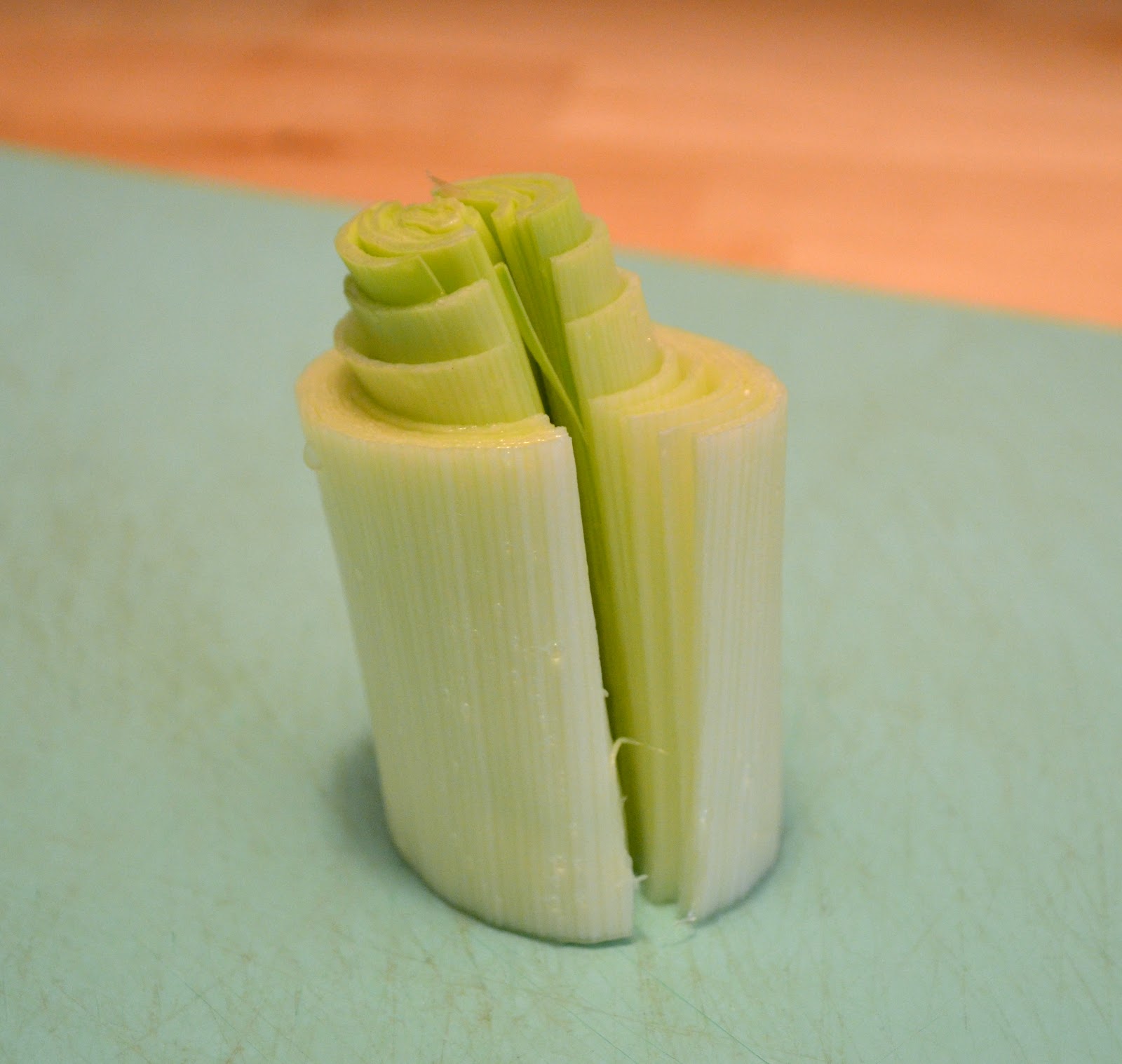
Split your leek down the middle. And yes, I have been practicing horticulture on a small scale inside my fridge. 

Lay both side down flat, and make the thinnest slivers you can with a sharp knife. 

The thinner the better - mine aren't really ideal... I'm sure you could do better!

In a bowl, mix the leek, sesame seed oil, Chinese chicken bouillon powder and dash of black pepper. Combine well and let it sit while you get the noodles. 

Yes, I realize that chicken bouillon powder has MSG in it. But no, I would not replace it with anything else in this dish. My take on MSG is this - sure, it's not natural, but it's not necessarily evil. A bit of it (chicken bouillon powder) now and then goes a long way and it's indispensable in some Chinese dishes, those that don't involve soy sauce or oyster sauce. 

Open the package of noodles into a fine-meshed sieve and and rinse under cold water for a minute. Drain really well - leave the sieve over a bowl for a few minutes if you aren't too hungry. 

Toss with the leek mixture and serve. You can garnish it with a few lettuce leaves, or even add some other vegetables, such as cucumbers or red or green peppers - just cut them as thinly as possible, like the leeks. You can also add a small splash of vinegar, if you like sour food. I do!

If I'm not too hungry, this salad alone is enough for lunch. Otherwise, I'd serve it with any Asian food - Chinese or Japanese, usually. Itadakimasu!

Read More

Rice with burdock (gobo)

So here's my first post, with photos taken with my new camera. After looking at these, my old iPhone photos are... a pain in the eye.

I was wandering around downtown yesterday looking for presents and things for my Halloween costume. Since there's a very nice Japanese food store in Soho, I stopped by to get gobo, (burdock root) one of my favourite Japanese ingredients. Here's a simple rice dish I love - simple and healthy.

You will need:
"3 cups" of short grained white rice (in this case, 1 "cup" is 180cc, or about 3/4 normal cup. So you need a total of 2 and 1/4 cups)
3 tablespoons soy sauce
half a stick (about 15 to 18 inches) of burdock root (gobo)
(1/4 cup sake if you have it)

You will also need a rice cooker.

Serves 4

Peel the skin of the burdock with a vegetable peeler. Using a sharp knife, make 4 or 5 incisions lengthwise in the burdock. Don't cut all the way through (although it's not a disaster if you do - I just find it easier to manage if the sticks are still connected at some point.)

Using the peeler again, shave it into slivers about a couple of inches long. As you go up, make more incisions - just to shave it into slivers instead of wide thin slices. using a sharp knife, thinly slice whatever the peeler can't shave. 

Plunge into cold water and leave for 5 minutes. Burdock root oxidizes very quickly. Soaking it in water will help it release some of that brown color and a slight bitter taste. 

In the meanwhile, wash your rice at least 10 times or until the water runs clear. Just massage it through your hands. By the way, if you have any glass jars or tupperware that smells of tomato sauce or garlic or whatever used to be in it, soak it in the water from washing the rice over night and the smell will disappear completely. Very handy. 

Put the rice in the pot of the rice cooker, drain the burdock and put it over the rice. Add the soy sauce and a little sake if you have some. (I didn't.) Fill the pot with water up to the "3" mark. Cook. 

When it has finished cooking, unplug the rice cooker. Open, and quickly mix the rice and the burdock, being careful not to squash or mash the rice. Close the lid and let stand for 5 to 10 more minutes. Serve.

I had this for lunch with a bit of grilled salted salmon. Miso soup would have been a great addition, too!

Read More

Baby bok choy salad

Baby bok choy is common in Japan (but only the young leaves; we never see the sturdier ones in Japan) but they're usually eaten cooked. A nice green vegetable that I never paid much attention to - until I tried it raw in a salad at a dinner with friends - and since then, it's basically been my go-to salad green. 

Actually, a lot of greens eaten raw in many countries are cooked in Japan. Raw spinach is not so common there, and my parents were quite shocked when they heard that in Russia we eat napa cabbage raw. I think I still prefer napa cabbage cooked (especially the thick stems) but bok choy I now prefer raw. 

3 baby bok choy - choose tender ones, not the ones on the verge of turning into tough monsters
3 teaspoons sesame seed oil
2 teaspoons soy sauce
1 teaspoon sugar (any kind)
1 teaspoon white vinegar (you can use any kind, as long as it's white. No Balsamic. God forbid.)
2 teaspoons sesame seeds 

First, cut them the bok choy half, starting from the stem. 

Again cutting from the stem, cut them into wedges, This should make it easier to cut into wedges without everything falling apart. If they do, it's no big deal - I cut them into wedges chiefly for the looks of it. 

You can't say this isn't pretty. 

In a small bowl, combine the dressing ingredients. If your sesame seeds aren't toasted, you can do that by putting them in a small frying pan and tossing them over high heat for half a minute or until you start to smell them. (Do not let them turn brown.)

Toss the bok choy with the dressing in a large bowl, and serve immediately. Do not toss the salad ahead of time - it will make the lovely green wilt and they will not taste as luscious. 

Serves two. 

You can also make loads of this dressing and keep it in the fridge in a jar. I also use it on normal salad, tomatoes, whatever I have lying around. 

You can also use a mix of white and black sesame seeds, or black. 

Read More

Artichoke risotto

Ever since I had my first steamed artichoke with vinaigrette (I'm not talking about the canned stuff found in salad bars here!) I've been mildly obsessed with them. Artichokes aren't to be had in Moscow, but here in New York, they're plentiful, fresh and sometimes inexpensive.

After about three weeks of steaming artichokes, I finally ventured into new territory: artichoke risotto. I've never tried any, and I'm not sure I ever noticed one on a restaurant menu, but I was sure artichokes would be a great addition to risotto, and I combined its rich, slightly quirky flavor with a sharp old Pecorino cheese. Result? Lovely.

Here's what I use:
per person:

1 large artichoke
1/2 medium onion
1 clove garlic
1/2 cup rice (arborio, or sushi rice - short grain white rice, unwashed)
2 tablespoons olive oil
1/2 cube vegetable (or mushroom) bouillon
1 cup dry white wine
1/4 cup grated Pecorino cheese (plus more for garnish)
sprinkle of salt and freshly grated black pepper
1 lemon

Caution - artichokes are prickly.

Lop off the top; about an inch and a half. Lop off the stem if it's very long; you can leave about an inch on.

Prepare a bowl of water with half a lemon squeezed into it. Artichokes oxidizes rapidly; you will dip it in the lemon water as you work, and keep them submerged until they are ready to cook.
Next, pull back and break off some of the outer leaves - actually petals - about 20 or 30 of them.

Using a vegetable peeler (you can use a knife, but I find it easier with a peeler) peel/scrape away most of the tough outer parts.

You want to take away most of the fibrous green material, and leave just the white parts close to the stem.

This artichoke still needs more work.

Cut that in half - isn't that beautiful?

Dip both halves in the lemon water and leave one of them there, while you scoop out the hairy feathery middle with a (sturdy) teaspoon. You will want all of that pretty purply stuff gone. And be careful, they look pretty but they're very prickly.

Here are the cleaned artichoke halves. You will have far, far more garbage than edible parts. But that's just how artichokes are. Love them or hate them.

Lay the halves face down, and slice into wedges about a quarter of an inch thick.

Submerge in the lemon water again until ready to use.

Finely chop the garlic, dice your onion, and saute in olive oil over medium high heat.

Add the rice and continue stirring, until the rice turns slightly translucent.

Add the artichokes, and turn up the heat as high as it will go and continue tossing and stirring to avoid burning.

When everything is really really hot...

... pour in the wine, all at once. Stir quickly.

If you're feeling very fancy, you can use dry white champagne.

When the wine has almost completely evaporated, add half a cup of water, and crumble in the cube of bouillon. 

Continue stirring and cooking over high heat, adding half cups of water as it evaporated. 

Cook for 15 or 20 minutes, until the rice is still  firm, but not crunchy any more. You want it al dente, not porridge-like. 

Turn off the heat, and sprinkle in the Pecorino cheese and give it a quick stir. Season with salt and pepper to taste. 

You can also add a sprinkle of lemon juice here if you like tart food - I do!

Sprinkle a little more Pecorino on top and serve immediately. It makes a good filling dinner even if it is vegetarian, and goes well with salad of any kind. Just be careful with wine, though, because artichokes have a chemical that change taste perception in your mouth and your wine won't taste the same. 

Enjoy!


Read More

Cream soup with sweet red pepper

After spending so many of my vacations (basically all of them the past several years) with my friend and almost sister Catherine, I have picked up not a little of her cooking. This simple yet filling and delicious soup is one she often made for dinner and it was easy to see why - not only is it not too heavy to eat in the evening; it is also very easy to make and for someone always working or studying and the mother of two kids, a quick nutritious meal is a godsend. 

I've changed very little from her soup, except for the substitution of crème fraîche for whatever local variant I have - smetana in Russia and sour cream in the U.S. - speaking of which, not long ago I wrote a whole newspaper column about this dairy product. I've also sprinkled some cheese on top instead of an extra dollop of sour cream - but that is optional.

Here is (some of, since I forgot a few) the cast of characters:

2 extra large sweet red peppers - or 3 large ones
2 medium onions
4 cloves of garlic
1 medium large potato (or in my case, several extremely small ones)
1 cup sour cream (more if you want to top your soup with it) - choose whatever fat content you wish!
1 cube vegetable bouillon (try to find vegetable or mushroom bouillon - the flavor of chicken or beef gives the soup a not only boring but unappetizing generic saltiness)
2 tablespoons olive oil (not shown because I am forgetful)
some shaved Parmigiano-Reggiano cheese for topping - optional (not shown)
salt and pepper to taste (also not shown)

Optional: half a packet of Boursin cheese with garlic and fine herbs for an especially rich velvety soup. 
Roughly chop up the garlic and onions, and saute in olive oil over medium heat until translucent.

Add the roughly chopped potato(es) and roughly chopped peppers and stir well. After a minute or so, put on the lid and continue cooking over medium heat - there should be enough moisture from the vegetables to keep them from burning or sticking to the pot (if not, lower the heat).

You want everything to sweat nicely - stir once every two three minutes, but otherwise keep the lid on and cook until the peppers start to wilt. 

Add a cup of water and the cube of vegetable stock and cook for ten more minutes, or until the potatoes are cooked. 

Lower the heat and add the sour cream or  crème fraîche (or smetana). If using Boursin cheese, add it now. Stick an immersion blender in the pot and puree until smooth. 

If you are using crème fraîche, it will not curdle, but if you are using anything else, it is best to keep things at a very low simmer after this point. Add salt and pepper to taste - I usually add at least half a teaspoon of salt, but it depends on how salty your bouillon cube is. Also, if you add Boursin cheese, that is very salty, so add salt only at the very end. 

Top with the shaved Parmigiano-Reggiano and sprinkle with freshly ground pepper. 

This recipe serves two for a filling meal, or three if no one takes seconds! But better make more than less, because it is delicious and you will want seconds for sure. Serve with a crusty baguette and some cheese and a light green salad. 

You can also replace the red peppers in this soup with some other kind of vegetables - I've tried it with zucchini, pumpkin, green peppers, broccoli, or a mixture of several vegetables. You can also replace the onions with the white parts of leek, or use both the white and green parts for a leek soup. It will doubtlessly be a very fancy and beautiful soup made with asparagus. If using red pepper or pumpkin, you can also add some sun-dried tomatoes for a deeper flavor. 


Read More
 

©2009Figs in the Sun | by TNB